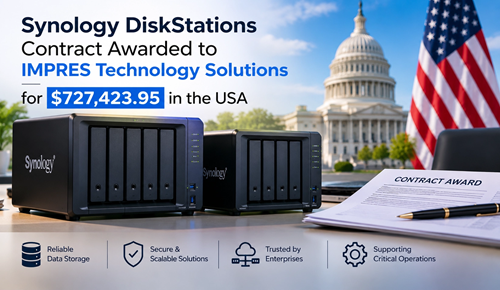
Synology DiskStations Contract Awarded to IMPRES Technology Solutions for $727,423.95 in the USA
14 Oct 2026
The Synology DiskStations contract award in the United States is valued at USD 727,423.95 and is associated with the U.S. Department of Homeland Security (DHS), specifically its Immigration and Customs Enforcement (ICE) organization. According to the supplied award information, IMPRES Technology Solutions, Inc. is the selected supplier for the Synology DiskStations procurement.The contract carries award number 70CMSD26FR0000081 and TenderOnTime reference number 27655516. The contracting office listed in the announcement is the Office of Investigations and Operations Support in Dallas, with a contracting office address in Irving, Texas.Synology DiskStations are network-attached storage (NAS) systems designed to centralize digital storage and provide file-sharing and data-management capabilities. The award is relevant to the government IT procurement sector because it involves the acquisition of storage technology for an organization operating within the U.S. federal government.The supplied record lists a contract value of USD 727,423.95 and a contract date of August 10, 2026. However, the date should be verified against the original procurement notice before publication because the raw data contains a conflicting year entry.Synology DiskStations Contract Award: Key DetailsContract name: Synology DiskStationsContract award number: 70CMSD26FR0000081TenderOnTime reference number: 27655516Country: United StatesContract value: USD 727,423.95Awarding organization: U.S. Department of Homeland SecurityContracting office: Office of Investigations and Operations Support, DallasWinning supplier: IMPRES Technology Solutions, Inc.Contract date: August 10, 2026, as reported in the supplied record; verification recommendedLast published date: August 11, 2026Contracting office address: 8222 N. Belt Line Road, Suite 2200, Irving, Texas 75063, USAProcurement classification: Original Set Aside, as stated in the supplied recordTender notice reference: 70CMSD26FR0000081The source data does not specify the number of storage systems, individual hardware configurations, delivery schedule, contract duration, or detailed technical specifications. These details should be confirmed through the original award notice or its associated procurement documentation.Detailed Analysis of the Synology DiskStations ContractWhat Are Synology DiskStations?Synology DiskStations are network-attached storage (NAS) devices that allow organizations to store, organize, access, and back up digital files through a network. Depending on the model and configuration, these systems can support centralized file sharing, data protection, user access management, and other business IT functions.Synology describes its business solutions as covering data storage, backup, video surveillance, and business productivity. However, the award record does not identify the specific DiskStation models or confirm which capabilities will be used under this contract.For a federal organization, a storage hardware procurement of this kind may support several operational requirements, including:Centralized data storage: Keeping digital files accessible through managed network storage.Data backup and recovery: Supporting backup workflows when the relevant hardware and software are configured for that purpose.File sharing: Enabling authorized teams to access and exchange information.Storage management: Organizing digital records and managing available storage capacity.IT infrastructure support: Providing storage resources for existing applications and operational systems.These are general capabilities of network storage technology, not confirmed deliverables of this particular award.Why Is This Contract Award Significant?The USD 727,423.95 award represents a substantial procurement for specialized storage hardware. Its association with the Department of Homeland Security makes it relevant to businesses tracking federal information technology purchases.The contract may provide insight into demand for network storage products within the U.S. government procurement market. Nevertheless, the available information does not establish the exact operational purpose of the equipment, the number of units purchased, or whether the systems will support investigative, administrative, backup, or other workloads.For IT suppliers, the award highlights the importance of tracking government requirements for storage hardware, networking equipment, servers, data protection products, and related technology services.Country and Regional Overview: United StatesThe United States has a federal procurement system through which government departments and agencies purchase technology, equipment, construction, professional services, and other goods needed for their operations.This Synology DiskStations award is associated with the Department of Homeland Security and its Immigration and Customs Enforcement organization. The listed contracting office is the Office of Investigations and Operations Support in Dallas, with an address in Irving, Texas.The award is relevant to the U.S. government IT market because it demonstrates procurement activity involving network storage equipment. Potentially related markets include:Enterprise and network storage systemsServers and data center hardwareBackup and disaster recovery solutionsNetworking equipment and infrastructureIT hardware distribution and integrationTechnical support and infrastructure maintenanceThese are adjacent market segments, not confirmed components of the contract.Potential Opportunities for IT SuppliersCompanies interested in federal technology procurement can monitor official solicitation notices, award announcements, and agency purchasing requirements. Suppliers should review each opportunity's eligibility conditions, technical specifications, delivery requirements, and contract terms before deciding whether to bid.The designation "Original Set Aside" appears in the supplied award data. The exact set-aside category and any associated eligibility restrictions should be verified against the original procurement documentation rather than inferred from this label alone.About the Awarding Authority: U.S. Department of Homeland SecurityThe U.S. Department of Homeland Security is a federal department responsible for a range of homeland security functions. Its component agencies carry out operational and administrative activities that require technology, equipment, infrastructure, and support services.The award information identifies the department as the purchaser and names the Office of Investigations and Operations Support in Dallas as the contracting office.The contract is associated with U.S. Immigration and Customs Enforcement, commonly known as ICE, through its listed investigations and operations support office.The precise business or operational need behind the Synology DiskStations purchase has not been disclosed in the supplied record. It would therefore be inappropriate to claim that the equipment is specifically intended for evidence management, surveillance, intelligence, or any other particular use without further documentation.About the Winning Supplier: IMPRES Technology Solutions, Inc.IMPRES Technology Solutions, Inc. is identified in the award record as the successful supplier for the Synology DiskStations contract.Third-party federal contracting data also lists IMPRES Technology Solutions as a U.S. government vendor and identifies the company with a Round Rock, Texas location.The available award information does not establish whether IMPRES will supply hardware directly from the manufacturer, through a distribution arrangement, or as part of a broader technology solution. It also does not disclose any subcontractors, delivery partners, or manufacturer commitments specific to this purchase.Supplier Responsibilities Under the AwardThe precise contractual obligations are not available in the supplied summary. Depending on the final contract terms, a hardware supplier's responsibilities may include:Providing the specified storage devices and configurationsMeeting technical and compatibility requirementsDelivering equipment within the agreed scheduleSupplying required documentation and warranty informationCoordinating any installation or technical support explicitly included in the contractThese are typical procurement considerations, not a verified list of IMPRES's obligations under this award.Contract Value and Financial SignificanceThe reported contract value is USD 727,423.95.This figure is the stated value in the supplied award record. The available details do not clarify whether it represents the total potential contract ceiling, the amount obligated at award, a fixed-price purchase, or a value inclusive of all options and ancillary services.No currency conversion is necessary because the award is already reported in U.S. dollars.What the Contract Value Tells UsThe value makes this award relevant to suppliers and contractors researching government spending on storage hardware and IT infrastructure. However, the amount alone does not establish the number of devices, the unit price, the commercial margin, or the financial impact on the winning supplier.To assess those details accurately, readers would need the original award documentation, including any line-item pricing, quantities, delivery requirements, and funding information.Procurement Process and Award DetailsThe available award record identifies IMPRES Technology Solutions, Inc. as the supplier and provides the contract award number. However, it does not disclose the complete procurement history or evaluation process.The following details remain unconfirmed:Original solicitation publication dateBid submission deadlineNumber of companies that submitted bidsBidding and evaluation methodologyTechnical and commercial selection criteriaWhether the purchase was competed or awarded through another procurement mechanismDetailed contract terms and conditionsThe classification "Original Set Aside" appears in the supplied record, but it does not by itself establish the precise eligibility restrictions or bidding method.Under the U.S. Federal Acquisition Regulation, a small-business set-aside generally restricts an acquisition to eligible small businesses under the applicable program rules. The exact classification for this award should be checked against the original solicitation. Acquisition.gov+1Businesses researching this award should consult SAM.gov and USAspending.gov for the original solicitation, award documentation, and additional federal spending information.Project Timeline and ImplementationThe supplied announcement contains two relevant dates:Contract date: August 10, 2026, according to the summary, although the raw record also contains the apparent typo "10 Aug 2926."Last published date: August 11, 2026.The August 2026 date is consistent with the publication information found in a third-party federal contracting database, which lists the Synology DiskStations award to IMPRES Technology Solutions, Inc. for approximately USD 727,424.The following implementation details have not been provided:Equipment delivery dateContract commencement dateInstallation or configuration scheduleAcceptance testing requirementsContract completion dateWarranty or maintenance periodConsequently, no implementation deadline or completion date can be established from the available information. The final contract documents would be needed to confirm these details.Industry Impact and Potential Business OpportunitiesImplications for the Government IT SectorThe award demonstrates procurement activity involving network storage technology within the U.S. federal government. Its potential relevance extends to businesses that supply storage hardware, networking equipment, data backup products, and related IT infrastructure.Synology's published business materials describe solutions for storage, backup, data protection, and surveillance. These capabilities illustrate the broader technology market in which DiskStation products operate, although the specific intended use under this award remains undisclosed.Opportunities for Technology SuppliersCompanies seeking similar procurement opportunities may consider monitoring the following categories:Network-attached storage and enterprise storage equipmentComputer hardware and server systemsData backup and recovery technologyNetwork infrastructure and connectivity equipmentIT distribution and integration servicesHardware maintenance and technical supportThese categories may help suppliers identify relevant future notices, but this award does not guarantee additional contracts or establish that any related procurement is planned.What Businesses Should Monitor NextIT suppliers and government contractors can monitor official procurement portals for new solicitations, amendments, award announcements, and recurring hardware requirements.Before pursuing an opportunity, businesses should review the solicitation's technical requirements, contract type, eligibility conditions, delivery schedule, and pricing structure. They should also distinguish between an awarded contract and a new invitation to bid, since the two represent different stages of the procurement process.Key TakeawaysContract: Synology DiskStations procurement.Winning supplier: IMPRES Technology Solutions, Inc.Awarding organization: U.S. Department of Homeland Security.Associated contracting office: Office of Investigations and Operations Support, Dallas.Location: United States, with the contracting office in Irving, Texas.Contract value: USD 727,423.95.Award number: 70CMSD26FR0000081.TenderOnTime reference: 27655516.Publication date: August 11, 2026, according to the supplied record.Outstanding details: Exact equipment specifications, quantities, funding arrangements, delivery dates, contract duration, and procurement method have not been established.ConclusionThe Synology DiskStations contract award, valued at USD 727,423.95, identifies IMPRES Technology Solutions, Inc. as the supplier for a procurement associated with the U.S. Department of Homeland Security. The award is relevant to businesses tracking federal IT hardware purchases, network storage systems, and government technology procurement.Although the award value and contract reference are available, the detailed scope, delivery schedule, and procurement evaluation process require further verification through official documentation. Confirming these details will provide a more complete understanding of the purchase and its operational significance.Businesses interested in similar opportunities can explore government IT tenders, technology procurement notices, and published contract awards on TendersOnTime. Monitoring official procurement sources alongside award announcements can help suppliers identify relevant requirements and prepare for future bidding opportunities.#SynologyDiskStations #SynologyContractAward #USGovernmentContracts #USAContractAwards #HomelandSecurity #ICEProcurement #IMPRES #ITProcurement #NetworkStorage #DataStorageSolutions #FederalITContracts #GovernmentProcurement #TechnologyTenders #ITHardwareTenders #ContractAwardNews
View Details
Oracle Health Wins $16.94 Billion Expanded VA EHR Contract Modification in the USA
21 Aug 2026
The U.S. Department of Veterans Affairs (VA) has awarded a major $16.94 billion contract modification to Oracle Health Government Services, Inc. to expand the scope of an existing electronic health records (EHR) indefinite-delivery/indefinite-quantity (IDIQ) contract. The award represents a significant investment in the modernization of healthcare technology supporting America's veterans.The modification was awarded on 18 August 2026 and published on 19 August 2026 under Contract Award Number 36C10B18D5000P00008.Major VA Healthcare Technology ContractAccording to the award notice, the modification applies to the DA01-VA EHRM IDIQ Contract 36C10B18D5000, with the expanded scope identified as Modification P00008 (VA-26-00083233).The reported contract value is USD 16,941,387,684.28. The procurement was managed by the VA's Technology Acquisition Center (TAC) in Eatontown, New Jersey, under Notice Reference 36C10B26R0015.The award builds on the VA's broader electronic health record modernization program, which is intended to improve how medical information is managed and shared across the department's healthcare system.Oracle Health Secures Expanded ScopeOracle Health Government Services, Inc., based in Kansas City, Missouri, received the contract modification. The company provides healthcare information technology and electronic medical record solutions to government and healthcare organizations.The expanded scope gives Oracle Health a continuing role in supporting the VA's EHR modernization environment. The initiative is strategically important because interoperable digital health records can help healthcare professionals access patient information more efficiently across participating facilities.Modernizing Healthcare for U.S. VeteransThe VA operates one of the largest healthcare systems in the United States, making reliable digital health infrastructure essential to delivering coordinated care to millions of veterans.EHR modernization can improve information accessibility, clinical workflows, data exchange, and administrative efficiency. It can also support more consistent digital processes across VA medical facilities and healthcare providers.The latest contract modification demonstrates the federal government's continued investment in enterprise healthcare technology and digital transformation.Strategic Importance of the AwardThe expanded contract represents a substantial commitment to maintaining and developing the VA's electronic health record capabilities. Large-scale federal technology programs such as this also create opportunities for software providers, cybersecurity specialists, systems integrators, and other technology companies participating in the government healthcare ecosystem.The award further strengthens Oracle Health's position in the U.S. federal healthcare IT market.Looking AheadWith Modification P00008 now awarded, Oracle Health Government Services is expected to continue supporting the expanded requirements of the VA's EHR modernization program. The initiative will remain closely watched as the Department of Veterans Affairs works toward improving digital healthcare infrastructure and technology-enabled services for veterans. #USA contract award, #VA contract award, #Oracle Health Government Services, #Veterans Affairs, #VA EHR modernization, #electronic health records, #healthcare IT contract, #federal technology contracts, #government contracts USA, #awarded tenders, #procurement news USA, #federal procurement, #healthcare technology management, #digital health records, #EHR IDIQ contract, #VA technology acquisition, #public sector IT, #contract modification, #tender results, #$16.94 billion contract
View Details
Nightwing Intelligence Solutions Wins $1 Trillion GSA OASIS+ Contract
19 Aug 2026
The U.S. General Services Administration (GSA) has awarded a potentially landmark federal contract to Nightwing Intelligence Solutions, LLC under the OASIS+ Unrestricted Multiple Agency Contract (MAC) program. The contract, valued at up to $999.999 billion, expands the pool of contractors available to federal agencies seeking professional support services through the government-wide acquisition framework.The award was made on 30 July 2026 under Contract Award Number 47QRCA26DU016 and published by the GSA/Federal Acquisition Service on 7 August 2026.Major Federal Contract AwardThe procurement, identified as R--GSA OASIS+ MAC Program Unrestricted IDIQ, carries Notice ID 47QRCA23R0006. The contract is part of the One Acquisition Solution for Integrated Services Plus (OASIS+) program, a government-wide contracting vehicle designed to provide federal agencies with streamlined access to professional services.The reported base-and-all-options value is $999,999,999,999, making it one of the largest potential contract ceilings listed in the award notice. The award has no specific task or delivery order number listed at this stage.The contract is classified under Product Service Code R499 – Support-Professional: Other.Supporting Federal Agency ProcurementOASIS+ is designed to help federal agencies acquire a broad range of professional services through multiple-award contracts. The unrestricted structure allows eligible agencies to compete task orders among qualified contractors for individual requirements.For federal buyers, such acquisition vehicles can reduce procurement timelines while providing access to specialized capabilities and experienced service providers.The GSA/FAS/PSHC/OASIS PLUS office in Washington, D.C., managed the procurement. The primary point of contact listed in the award notice is Jean-Louis, Tyronza.Nightwing Intelligence Solutions Secures AwardNightwing Intelligence Solutions, LLC, based in Dulles, Virginia, was selected for the OASIS+ unrestricted contract. The company will be positioned to compete for future task orders issued by participating federal agencies under the framework.The award gives Nightwing access to a major federal contracting vehicle and potentially significant opportunities across professional support requirements.Strategic Importance of OASIS+The OASIS+ program is an important component of the U.S. government's federal acquisition strategy, providing agencies with flexible contracting options for complex professional service requirements.While the reported $999.999 billion figure represents the total contract ceiling including base and all options, it should not be interpreted as an immediate payment or guaranteed revenue to Nightwing. Actual spending would depend on future task orders and agency requirements.Looking AheadWith the contract award now active, Nightwing Intelligence Solutions can compete for applicable federal task orders under the OASIS+ framework. The award highlights the continued expansion of government-wide acquisition vehicles designed to simplify federal procurement and connect agencies with qualified professional service providers. #USA contract award, #GSA OASIS+, #OASIS Plus contract, #Nightwing Intelligence Solutions, #GSA procurement, #federal government contracts, #U.S. government tenders, #IDIQ contract, #USA procurement news, #awarded tenders, #government contracts USA, #GSA contract award, #professional services procurement, #federal acquisition, #OASIS+ MAC, #Washington DC procurement, #Dulles Virginia contractor, #tender results, #contract award news, #U.S. federal contracts
View Details